The church teaches that David (who
became king and ancestor of Jesus) and Jonathan (the princely son of King Saul)
were merely the best of platonic friends and godly spiritual brothers, and,
though it is true that they committed startling sins, including adultery,
murder, adultery, genital mutilation of their enemies, adultery, some more
murder, and, uh, adultery, there is no way (says the Christian Church) that the
two men could have been married lovers.
Yet, even if we were to agree for just
a lightning fast moment that homosexuality is "a sin like all other sin or
temptation", considering all the other horrendous sins David committed,
why then would it be so shocking and terrifying to discover that David lived a
homosexual relationship with Jonathan?
"Gasp! No! Say David was ANY other
wicked thing but gay!"
Well goodness gracious, let's all go
berserk at the very idea! And why does everyone go berserk and vigilante at
this idea? Because they are thinking fleshly as man thinks, not as God thinks.
So, let's behave ourselves, give our brains a temporary stress relief by
putting our biases on hold for five minutes and see what the Word of God
reveals about them. David and Jonathan were married and it was not a sin, and
it's time we stop sweeping it under the rug for fear that our cathedral will
come crashing down around us.
I believe that all parties are in
agreement that David and Jonathan were best friends and "godly brothers in
the Lord". No one's arguing there. But contrary to what the church
willingly closes their eyes to, the Bible says quite a great deal more about
their relationship that unequivocally proves that they were more than just good
friends and brothers, and that’s what we’ll discuss in this chapter.
But before we do so, I would like to
mention a little tidbit that will help you understand the forthcoming
information. There are two terms mentioned in the Bible which specifically
refer to sex: "confusion" and "to uncover (a person's)
nakedness". Some examples include, to lie with an animal is called
"confusion" and to lie with your mother is to "uncover your
father's nakedness". These can be found throughout the Levitical laws, in
several combinations, pertaining to sex. Now, on to the topic at hand.
The story of the relationship between
David and Jonathan begins in 1 Samuel 18:1-3 where we are told that
"It came to pass,
when he [David] had made an end of speaking with Saul, that the soul of
Jonathan was knit with the soul of David, and Jonathan loved him as his own
soul....Then Jonathan and David made a covenant, because he loved him as his
own soul."
Now, this is the very definition of a
marriage - two souls knit together in love, and bound with a covenant. Had this
same event taken place between a man and a woman, no one would question that it
referred to a marriage, and we wouldn’t be having this conversation. There
would be no question whatsoever that this was a marriage if this verse said,
"And it came to
pass, when she [Tina] had made an end of speaking with Saul, that the soul of
Mike was knit with the soul of Tina, and Mike loved her as his own soul...
Then Mike and Tina made a covenant, because he loved her as his
own soul."
Though both men LATER took wives (mainly
because there would have been a need for an heir to the throne, of which BOTH
of them were contenders), Jonathan and David were an "item" before
other women came into the picture. So this would not be an argument in favor of
the Levitical laws and Romans 1, which outlaws a heterosexual man who leaves
the woman for a man. The women came later - so at the most, David and Jonathan
both left the MALE for the FEMALE. And to be precise, David and Jonathan's
relationship only ended because Jonathan was killed in battle. If you continue
to read 1st Samuel chapter 18, following the union of David and Jonathan,
David's nearly forced marriage to his first female spouse (King Saul's daughter
Michal) was a devious plot concocted by Saul to destroy David. The whole ugly
affair with Michal was hardly an issue for or against same/opposite sex
attraction and love; it was purely a political move, as we see the main issue
was getting David to produce a royal heir with Saul's daughter - which David
absolutely refused at first (after all, he was already bound to Jonathan, but
as we all know David later had no problem with having multiple spouses).
In fact, when Saul presents the idea of
a marriage between David and Michal, Saul clearly states in 18:21, less than
twenty verses after David and Jonathan make their covenant, that
"Thou shalt this
day be my son in law in the twain."
"In the twain” means "in the
two", or in modern English it means that any future marriage between David
and Michal would make David the son-in-law of Saul "A SECOND
TIME"/"ONCE AGAIN". Saul is acknowledging here that he is
already David's father-in-law (through Jonathan) and that now he will be again
through Michal. (Some people claim that this statement was referring to Saul's
earlier attempt to marry off his other daughter Merab to David, but by the time
of this remark from Saul, Merab was already married to someone else and out of
the picture, so it simply could not refer to Merab & Michal, but only to
Jonathan & Michal).
Later, in 1st Samuel 20, David runs
(literally) to Jonathan and expresses his fears over King Saul's recent change
of attitude toward him, saying, "What have I done?! What is mine iniquity?
And what is my sin before thy father that he seeketh my life?!" Jonathan
tries to console him by saying that there is nothing to fear because his father
would never make a move without first consulting with him. David responds by
swearing and then by saying to Jonathan,
"Thy father
certainly knoweth that I have found grace in thine eyes! ...Truly as the Lord
liveth and as thy soul liveth, there is but a step between me and death!"
And Jonathan immediately consoles his
lover with words of romantic tenderness that a prince does not say to mere
subjects, even if they are friends:
"Whatsoever thy
soul desireth, I will even do it for thee.”
Bear in mind that through all of this
no one but the High Priest Samuel had the slightest idea that David was ever
going to be king. He was just a shepherd and a good warrior.
Immediately after this discussion,
David asks Jonathan what their back-up plan should be depending on the king's
reaction to Jonathan’s cover story as to why David has not been showing up to
Saul’s banquet. But ignoring David's question - or maybe because of his
question - Jonathan changes the subject to discuss their covenant, ensuring the
binding their two houses together, something done only by marriage:
And Jonathan said unto
David, "Come, and let us go out into the field." And they went out,
both of them, into the field. And Jonathan said unto David, "O LORD God of
Israel! When I have sounded [told] my father about to morrow any time, or the
third day, and, behold, if there be good toward David and I then send not [this
information] unto thee, and shew it thee; [then may] the LORD do so and much
more to Jonathan! But if it please my father to do thee evil, then I will shew
it [make it known to] thee, and send thee away that thou mayest go in peace [safely]:
and the LORD be with thee, as He hath been with my father. And thou shalt not
only (while yet I live) shew me the kindness of the LORD, that I die not, but
also thou shalt not cut off thy kindness from my House for ever - no, not when
the LORD hath cut off the enemies of David, every one, from the face of the
earth." So Jonathan made a covenant with the House of David, saying, "Let
the LORD even require it at the hand of David's enemies!" And Jonathan
caused David to SWEAR AGAIN, because he loved him - for he loved him as he
loved his own soul.”
-1 Sam 20:11-17.
Then David tells Jonathan that he is
too afraid to attend Saul's upcoming banquet, and the two men plot a scheme so
that David doesn't have to go. Then Jonathan, out of his love for David, lies
to his father the king about David's where-abouts to protect him. But Saul sees
right through it all, and, KNOWING that his son and David are involved in a
ROMANTIC and SEXUAL covenant relationship, declares to him in verse 30,
"Thou son of the
perverse rebellious woman! DO NOT I KNOW THAT THOU HAST CHOSEN THE SON OF JESSE
(David) TO THINE OWN CONFUSION, AND UNTO THE CONFUSION OF THY MOTHER'S
NAKEDNESS?!"
Is it possible to be more blunt than
that? Could Saul have been any plainer without using profanity? In fact, I’d
say that was fairly graphic language for that era.
King Saul knew EXACTLY what was going
on between those two young men - and anyone else with eyes could see it too.
And Saul is now so jealous of David that he lashes out against his son’s love
for David that he nearly murders his own son. The very words used by King Saul
make it abundantly clear that David and Jonathan were indeed in a married
relationship with each other.
This is confirmed by David's famous
(and public) love psalm to Jonathan upon his death in 2nd Samuel 1:26:
"Very pleasant hast
thou been unto me: thy love to me
was wonderful, PASSING
THE LOVE OF WOMEN."
“Passing” means “surpassing/going
beyond”. What is particularly fascinating about that statement it that the word
“passing” does not exist in the Hebrew of this verse! It is an italicized word,
meaning that it was added by the translators to complete the sentence in
translation. Literally, in Hebrew, this verse says, “thy love to me was more
wonderful than the love of women”. In EITHER translation, romantic/sexual love
is clearly the meaning behind “the love of women”, and David is screaming in
your face with a megaphone that their same-gender love was MORE WONDERFUL than
what they experienced with women.
It would be nonsensical to insist that
David’s statement here was merely a gesture of affection between two good
buddies. Heterosexual men - in ANY age - do not use such romantic and sexually
charged words with one another; and they certainly wouldn't write love poems to
each other.
In fact, note here that David uses the
word "love" twice in this sentence, both times in reference to their
relationship. Now, of course one might propose that this was
"brotherly" love or "friendship" love. However, the
Scriptures themselves tell us that this "love" was not merely
platonic. The Hebrew word for “love” used toward Jonathan by David here in 2st
Samuel 1:26 is "ahabah" (ah-haa-bah) - and in this same book, in
13:1-15, uses the EXACT same word when discussing Amnon's romantic and sexual
love for his half-sister Tamar before he turned against her.
Please pay very close attention to this
passage:
“Absalom the son of
David had a fair sister whose name was Tamar; and Amnon the son of David loved
(AHABAH) her. And Amnon was so vexed, that he fell sick for his sister Tamar,
for she was a virgin and Amnon thought it hard for him to do any thing to her.
But Amnon had a friend whose name was Jonadab the son of Shimeah, David's brother.
And Jonadab was a very subtil man. And he said unto him, ‘Why art thou, being
the king's son, lean from day to day? wilt thou not tell me?’ And Amnon said
unto him, ‘I love (AHABAH) Tamar, my brother Absalom's sister!’ And Jonadab
said unto him, ‘Lay thee down on thy bed and make thyself sick; and when thy
father cometh to see thee, say unto him, ‘I pray thee, let my sister Tamar come
and give me meat, and dress the meat in my sight, that I may see it and eat it
at her hand.’’ So Amnon lay down and made himself sick. And when the king was
come to see him, Amnon said unto the king, ‘I pray thee, let Tamar my sister
come and make me a couple of cakes in my sight, that I may eat at her hand.’
Then David sent home to Tamar, saying, ‘Go now to thy brother Amnon's house and
dress him meat.’ So Tamar went to her brother Amnon's house, and he was laid
down. And she took flour and kneaded it, and made cakes in his sight and did
bake the cakes. And she took a pan, and poured them out before him - but he
refused to eat. And Amnon said, ‘Have out all men from me!’ And they went out,
every man, from him. And Amnon said unto Tamar, ‘Bring the meat into the
chamber that I may eat of thine hand.’ And Tamar took the cakes which she had
made and brought them into the chamber to Amnon her brother. And when she had
brought them unto him to eat, he took hold of her, and said unto her, ‘Come lie
with me, my sister.’ And she answered him, ‘Nay, my brother, do not force me;
for no such thing ought to be done in Israel! Do not thou this folly! And I,
whither shall I cause my shame to go?! And as for thee, thou shalt be as one of
the fools in Israel! Now therefore, I pray thee, speak unto the king; for he
will not withhold me from thee.’ Howbeit he would not hearken unto her voice, but,
being stronger than she, forced her, and lay with her. Then Amnon hated her
exceedingly so that the hatred wherewith he hated her was greater than the love
(AHABAH) wherewith he had loved (AHABAH) her.”
It is IMPOSSIBLE to interpret David's use
of "love [ahabah]" for Jonathan as any other thing but
romantic/sexual love. Yes - he loved him as a friend and as a brother. No one
is disputing that fact. But THE BIBLE says that was not the ONLY way they loved
one another - they loved one another ROMANTICALLY.
I would also like to note again that
these are hardly words that "just friends" say to each other. In
fact, I would like to note here for the record that before I wrote this piece,
I spoke with several heterosexual men about it. Without telling them that I was
quoting the Bible or explaining upfront what I was doing, I told them the words
of this verse and asked them what they would think if a man wrote them such a
poem. Every single one of them said that I would be implying that we had had a
sexual or romantic relationship. In fact, so romantic is this statement of
David that it bears the same flavor of the love story in Song of Solomon.
Say you are a court judge. The case is
the People vs. David & Jonathan. The prosecution must prove that David and
Jonathan were a married couple, while the defense attempts to protect an
anti-gay belief. Their case is that David was Jonathan's biblically lawful
lover and therefore homosexuality is not forbidden. The defense says they were
NOT lovers, therefore homosexuality is not supported by this story. (I am not a
lawyer, so please pardon any misapplied legal terms).
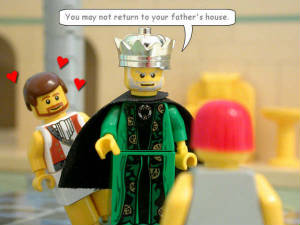
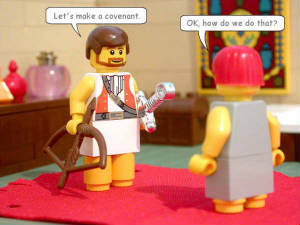
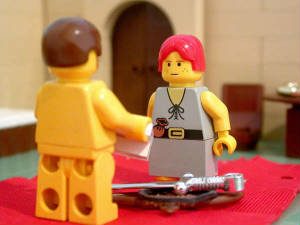
The prosecution hereby presents to the
court the following documented evidence (with pictures courtesy of
BrickTestament.com), your Honor: